Avoid Probate
Both revocable and irrevocable trusts can hold assets outside the probate process when ownership is properly coordinated with the trust.
The difference between a revocable and irrevocable trust is more nuanced than the names suggest. Compare how each structure handles control, flexibility, taxes, asset protection, and other planning priorities.
Revocable and irrevocable trusts are not competing versions of the same plan, and neither is inherently better. They are different planning structures designed to accomplish different objectives.
A revocable trust generally emphasizes ongoing control and flexibility. An irrevocable trust can provide additional planning opportunities—such as asset protection and tax planning—but those benefits depend on how the trust is structured and drafted.
The right approach depends on what you are trying to accomplish. In some plans, the answer may not be one or the other, but a coordinated use of both.
Do you need power to revoke? A comparison of Revocable Trusts and modern Irrevocable Trusts
| Criterion | Revocable Trusts | Irrevocable Trusts |
|---|---|---|
| Settlor Control | Available. This feature can be included in the plan. | Different Structure. This feature is available, but works differently. |
| Avoids Probate | Available. This feature can be included in the plan. | Available. This feature can be included in the plan. |
| Plan for Incapacity | Available. This feature can be included in the plan. | Available. This feature can be included in the plan. |
| Preserve Privacy | Available. This feature can be included in the plan. | Available. This feature can be included in the plan. |
| Modification Flexibility | Available. This feature can be included in the plan. | Different Structure. This feature is available, but works differently. |
| Opportunity to Optimize Income Tax | Unavailable. This feature is not available. | Available. This feature can be included in the plan. |
| Lock-in Transfer Taxes | Unavailable. This feature is not available. | Drafting Dependent. This feature may be included depending on how the document is drafted. |
| Asset Protection from Lawsuits | Unavailable. This feature is not available. | Available. This feature can be included in the plan. |
| Protect a Special Needs Beneficiary | Unavailable. This feature is not available. | Available. This feature can be included in the plan. |
Revocable and irrevocable trusts can differ significantly in how they handle control, taxation, and protection. But many of the fundamental jobs a well-designed trust performs can be accomplished with either structure.
Both revocable and irrevocable trusts can hold assets outside the probate process when ownership is properly coordinated with the trust.
Both structures can establish who will manage trust assets and carry out instructions if the person creating the plan can no longer act.
Both can generally keep trust administration outside the public probate process, allowing family and financial matters to remain more private.
Both can include detailed instructions for beneficiaries, distributions, successor management, and how trust assets should be handled over time.
The distinctions between these structures often come down to how control, protection, taxation, and long-term flexibility are handled in practice.
The most important difference is not whether control exists, but who holds which powers and how those powers are divided.
A revocable trust generally gives the person who created it broad and continuing control. Trust assets can usually be managed, moved, sold, or removed, and the trust itself can generally be amended, restated, or revoked while the settlor has capacity.
That flexibility makes a revocable trust well suited to managing assets during life while establishing a plan for incapacity and death. The tradeoff is that retaining broad control generally limits some of the protection and tax-planning opportunities that can come from giving up certain powers.
An irrevocable trust changes how control is structured rather than necessarily eliminating it. Depending on the trust, powers may be divided among a trustee, trust protector, investment director, beneficiaries, and other decision-makers instead of remaining entirely with the settlor.
The settlor may still retain certain management, investment, or other powers without retaining unrestricted control over the trust. Which powers are kept, transferred, or divided depends on the planning objective and must be coordinated carefully with the protection, tax, or other benefits the trust is intended to provide.
How assets are owned and who can reach them can matter when a creditor or lawsuit enters the picture.
A revocable trust generally does not protect the settlor’s assets from the settlor’s own creditors. Because the settlor typically retains the unrestricted ability to control the property or take it back, the trust usually does not create the legal separation required for that type of protection.
That does not make a revocable trust ineffective; its primary purposes are simply different. It can coordinate ownership, avoid probate, provide a structure for incapacity, and direct how assets are managed and distributed over time. Asset protection for the settlor generally requires a different structure.
Certain irrevocable trusts can provide meaningful asset protection by changing the legal relationship between the settlor and the property. Rather than retaining unrestricted access, the trust can divide ownership, distribution authority, management powers, and beneficial use among different people or roles.
For example, a properly structured asset protection trust may place distribution authority with an independent trustee while allowing the settlor to retain appropriate management or investment powers. The protection depends on the particular structure, applicable law, timing, and how the trust is drafted, funded, and administered.
“Revocable” and “irrevocable” do not, by themselves, tell you how a trust will be treated for income tax purposes.
A typical revocable living trust generally does not create a separate income-tax strategy during the settlor’s lifetime. Because the settlor retains broad control, trust income is ordinarily treated much as it would be if the assets continued to be owned directly by the settlor.
Its primary role is therefore ownership and estate-plan coordination rather than changing how income is taxed. A revocable trust can still be an important part of a broader tax plan, but simply transferring assets into one generally does not create the income-tax planning opportunities associated with more specialized structures.
Irrevocable trusts can be designed in different ways for income-tax purposes, so “irrevocable” does not describe a single tax treatment. Depending on the structure, a trust may be tax-neutral to the settlor or create planning opportunities involving income, gains, deductions, or an anticipated transaction.
The appropriate structure depends on what the client is trying to accomplish and the assets involved. A significant business sale, real estate transaction, concentrated investment, or other liquidity event can make income-tax planning particularly important, but the tax result depends on how the trust is designed and implemented.
For families with substantial or rapidly appreciating wealth, ownership structure can affect how future value is treated for gift and estate tax purposes.
Because the settlor generally retains control over assets in a revocable trust, those assets ordinarily remain part of the settlor’s taxable estate. The trust therefore generally does not shift future appreciation outside the estate or, by itself, create significant gift and estate tax planning benefits.
For most families, that is not a problem. A revocable trust can still accomplish its foundational objectives, including probate avoidance, incapacity planning, and coordinated distribution of assets. Transfer-tax planning becomes more important when wealth, expected appreciation, or the size of a future transaction creates additional planning concerns.
Certain irrevocable trust strategies can transfer assets or future appreciation in ways that create gift and estate tax planning opportunities. By changing ownership and limiting particular retained powers, a properly structured plan may move future growth outside the settlor’s taxable estate.
Those strategies tend to become more relevant as wealth, expected appreciation, or the size of a future transaction increases. The result is not automatic simply because a trust is irrevocable; it depends on what is transferred, which powers are retained, how the trust is drafted and administered, and the particular tax strategy being used.
Irrevocable does not necessarily mean unchangeable. The difference is how changes are made and whose authority is required.
A revocable trust is intentionally designed to be relatively easy for the settlor to change. While the settlor has capacity, the trust can generally be amended, restated, or revoked as family circumstances, assets, laws, and planning objectives change over time.
That flexibility can make ongoing administration relatively straightforward when retaining control is the priority. The settlor can usually respond directly to changing circumstances without relying on the consent or authority of additional parties. That same flexibility, however, is one reason a revocable trust generally cannot provide some benefits that depend on restricting the settlor’s control.
An irrevocable trust generally cannot be changed through the same unrestricted power retained by the settlor of a revocable trust. But “irrevocable” does not necessarily mean “unchangeable.” A well-designed trust can include mechanisms that allow the structure to respond to changing circumstances.
Authority may be divided among trustees, trust protectors, directors, beneficiaries, and others, with different parties given different powers. Depending on the trust and applicable law, those mechanisms can provide meaningful flexibility while preserving the legal characteristics the structure was designed to create. The key distinction is not whether change is possible, but who has authority to make it.
planning fit
The right structure depends less on the label and more on what the plan needs to accomplish.
May fit when the priority is...
May fit when the priority is...
You want maximum ongoing control and the ability to adapt the plan as your circumstances change.
Protecting assets from future creditor or liability exposure is an important planning objective.
Your primary goals are avoiding probate, planning for incapacity, and keeping ownership and administration coordinated.
You are preparing for significant appreciation, a business sale, real estate transaction, or another major liquidity event.
You do not currently need advanced asset-protection or transfer-tax strategies to accomplish your planning goals.
Family wealth or expected growth makes gift and estate tax planning an important consideration.
You want a flexible foundation that can be updated or supplemented with more advanced strategies as your needs change.
You are comfortable dividing control, distribution, or management powers when doing so supports the plan’s protection or tax objectives.
A revocable trust and an irrevocable trust can serve different purposes within the same estate plan. A revocable trust can provide the flexible foundation for managing assets, planning for incapacity, and directing what happens at death, while an irrevocable trust can address specific protection, tax, or wealth-transfer objectives.
The question is not always which type of trust is better. It is which structure should hold which assets, who should control them, and what each part of the plan needs to accomplish.
For some families, a revocable trust is all that is needed. For others, the right approach may be a coordinated plan that uses a revocable trust for flexibility and one or more irrevocable trusts for more specialized objectives.
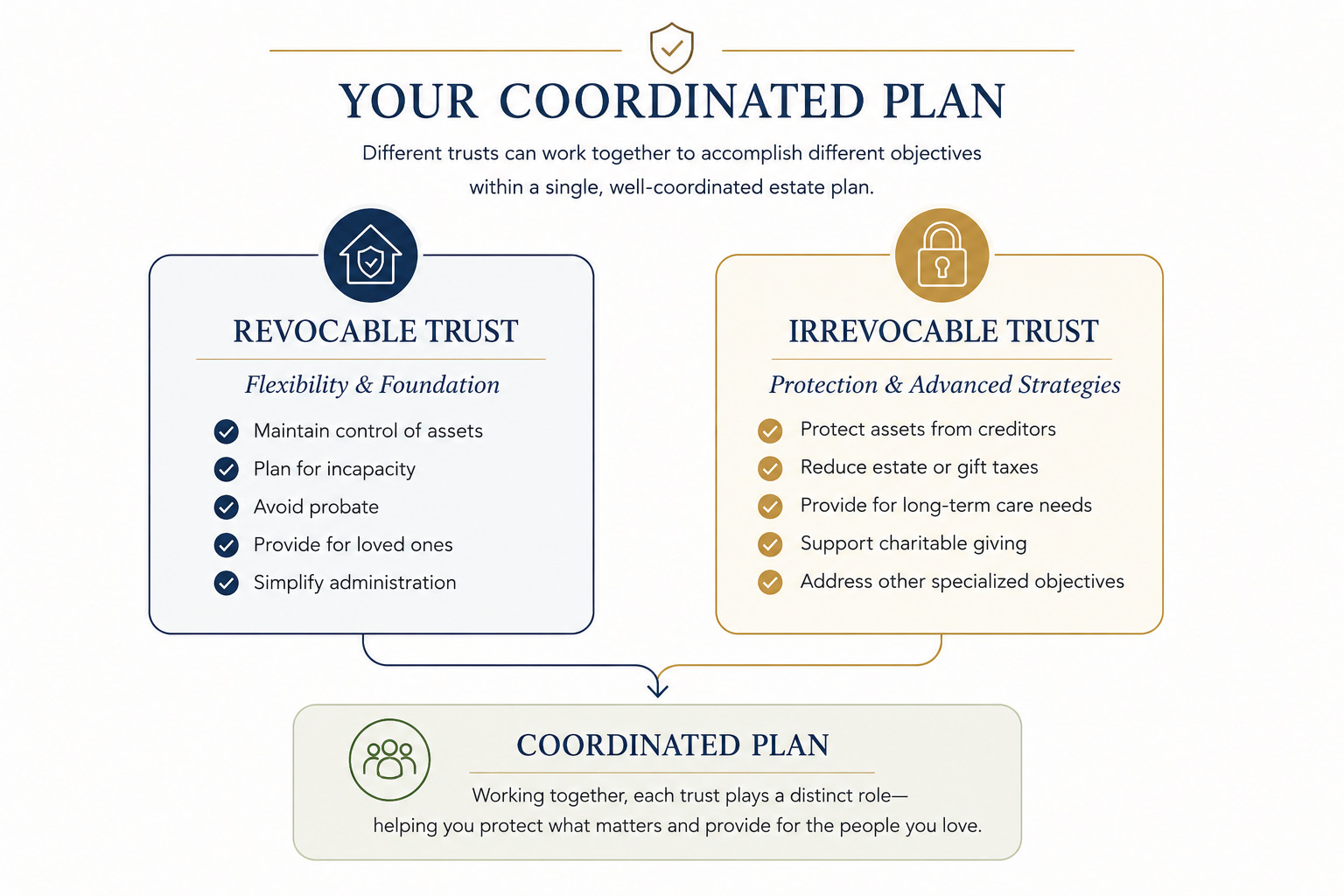
The goal is not to choose the most sophisticated structure. It is to use the right structure for each job.
COMMON MISCONCEPTIONS
The labels can make these trusts sound more absolute than they are. A few common assumptions are worth clearing up before deciding how either structure fits into a plan.
Myth
Reality
An irrevocable trust changes how control is structured; it does not necessarily eliminate it. Different powers can be divided among the person creating the trust, the trustee, beneficiaries, and other parties. The right arrangement depends on what the trust is intended to accomplish.
Myth
Reality
A revocable trust generally does not protect your assets from your own creditors because you still retain control over the trust and its property. Meaningful asset protection usually requires giving up certain rights or powers and using a structure designed specifically for that purpose.
Myth
Reality
Irrevocable does not necessarily mean unchangeable. Depending on how the trust is drafted and the circumstances involved, changes may be possible through powers built into the document, trustee or beneficiary actions, trust protectors, decanting, agreements, or court proceedings.
Myth
Reality
Irrevocable trusts are not automatically tax-saving vehicles. Tax treatment depends on how the trust is structured, who holds particular powers, what assets it owns, and the tax objective being addressed. In some situations, an irrevocable trust may provide significant tax advantages; in others, it may provide none.
Myth
Reality
These structures are not necessarily alternatives. A revocable trust can provide the flexible foundation of an estate plan while one or more irrevocable trusts address specific protection, tax, charitable, or wealth-transfer objectives. For some families, the right plan uses both.
Revocable and irrevocable trusts are designed to accomplish different things. The right approach depends on what you own, what you want to protect, the opportunities available to you, and what you want your plan to accomplish now and in the future.
We can help you identify those objectives first, then determine which planning tools make sense for your circumstances.