
Estate Planning Pricing
How Much Does Estate Planning Cost?
Estate planning can range from a straightforward foundational plan to sophisticated structures designed around lawsuit exposure, business transactions, taxes, and multigenerational wealth.
The right question is not simply, “How much does a trust cost?” It is what the planning needs to accomplish—and whether the investment makes sense in relation to the problem being solved.

Typical Estate Planning Costs
Estate planning fees vary because estate plans vary. A revocable trust designed to handle probate, incapacity, and family succession is fundamentally different from an asset protection structure or a tax strategy created around a major business transaction.
The ranges below provide a useful starting point for understanding the level of investment involved.
| Type of Planning | Typical Investment |
|---|---|
| Foundational Estate Planning | ~$3,000–$9,000 |
| Domestic Asset / Lawsuit Protection Planning | ~$7,500–$17,500 |
| Offshore Asset Protection Planning | ~$25,000–$50,000+ |
| Advanced Tax / Transaction Planning | Strategy-specific; Varies by strategy |
These are general planning ranges rather than quotes. The appropriate structure and fee depend on the scope of the engagement, the complexity of the planning, the time and professional judgment required, the amount at stake, the client’s family, assets, business interests, objectives, and other relevant factors.
Some strategies might involve separate costs for professional trustees, CPAs, financial advisors, valuation professionals, offshore service providers, or other specialists.
Why Can Estate Planning Prices Be So Different?
Two attorneys may both say they are creating a “trust” while providing very different levels of planning.
A trust document is only one part of an estate plan. The more important questions are what the document says, how it coordinates with everything else you own, and whether it actually accomplishes what you expect it to accomplish.
The work may involve determining:
- Who should have authority if you become incapacitated
- How assets should pass at death
- How and when beneficiaries should receive an inheritance
- How ownership should be coordinated with the trust
- Whether family or business circumstances require additional protection
- Whether existing LLCs, corporations, or other entities fit the overall plan
- Whether lawsuit exposure changes how assets should be owned
- Whether an upcoming sale or liquidity event creates a planning opportunity
- Whether tax planning is economically justified
You can buy documents inexpensively.
The harder question is whether those documents say what they need to say and whether the entire structure works together.

Planning vs. Paper
What You Are Really Paying For
The level of skill and experience required matters. Straightforward planning and highly specialized planning are not the same service, even when both ultimately result in a trust document.
A good estate plan reflects judgment about the family, the assets, the business, the risks, the jurisdiction, and the client’s objectives. The document is the tangible result of that work—not the entirety of the work itself.
The paper is the deliverable. The planning is the work.
foundational planning
Building the Structure Your Family Can Rely On
For many families, the starting point is foundational estate planning.
A foundational plan may include a revocable living trust along with wills, powers of attorney, health care documents, incapacity planning, asset-transfer documents, and instructions for what should happen when you can no longer make decisions yourself.
But even foundational planning is not one-size-fits-all.
A relatively straightforward family may need a simpler structure. Another family may benefit from separate trusts, inheritance protection, special-needs provisions, more sophisticated distribution terms, retirement planning, tax provisions, or multigenerational planning.
That is why asking, “What do you charge for a living trust?” only tells part of the story.
The better question is:
What do I hope to accomplish for my family?
advanced planning
Begins When the Goals Change
Foundational planning can accomplish a great deal, but it can only accomplish a certain amount.
As your wealth, business, investments, or risks change, your objectives may move beyond probate avoidance and family succession.
Advanced planning may become appropriate when you are trying to:
- Protect personal wealth from future lawsuit exposure
- Prepare for the sale of a business or another liquidity event
- Reduce or eliminate state or federal tax exposure
- Preserve wealth across multiple generations
- Coordinate charitable giving with other planning objectives
- Address unusual family, beneficiary, or business circumstances
The tools become more specialized because the problems become more specialized.
A revocable trust may be an excellent succession and incapacity tool. It is generally not designed for creditor protection.
Likewise, a basic estate plan is not designed to capture every tax opportunity surrounding a large business transaction.
The planning should evolve when the client’s circumstances evolve.
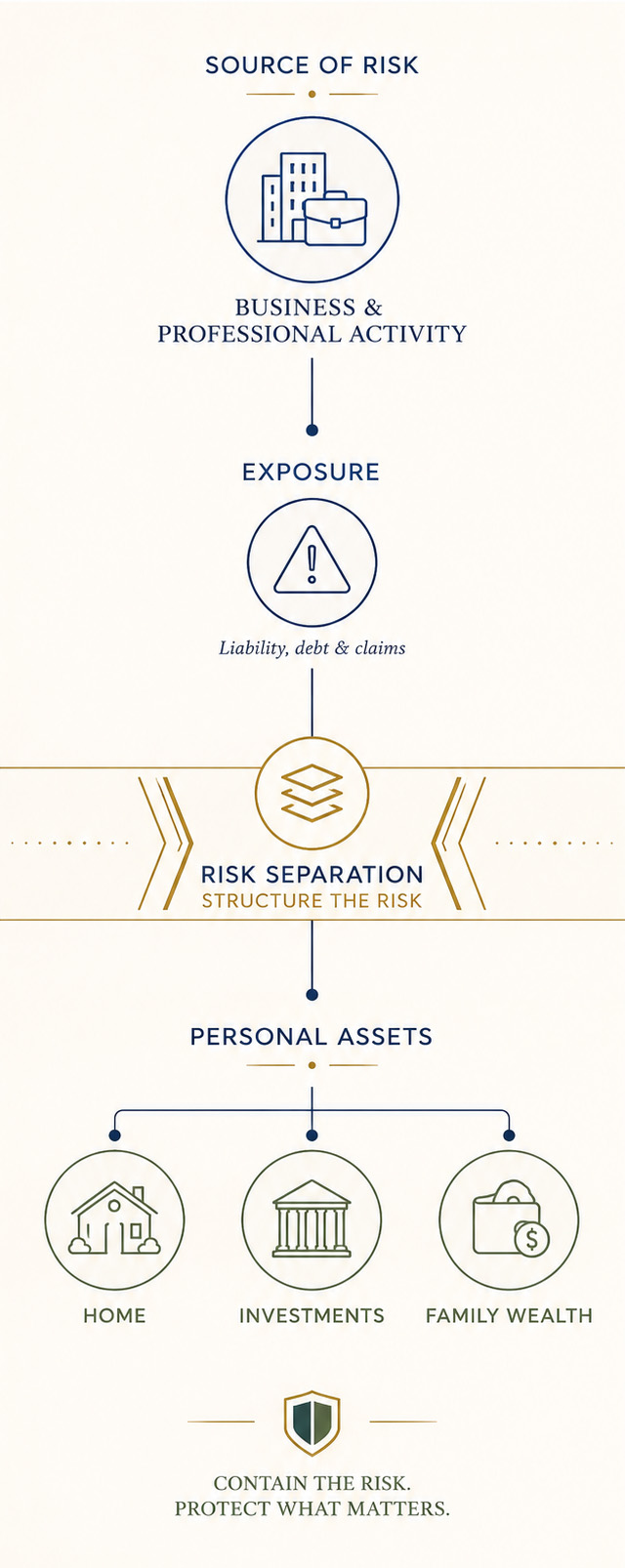
Lawsuit Protection Is About Managing Real Exposure
“Asset protection” can sound abstract.
For many business owners, founders, real estate investors, physicians, dentists, architects, builders, and other professionals, the more practical concern is lawsuit exposure.
A business owner may have employees, customers, leases, personal guarantees, business debt, professional liability, investment activity, or contractual obligations that create risks an ordinary household does not face.
Insurance remains an important part of the risk-management system. But insurance has limits, exclusions, deductibles, and other carve-outs that may leave some risks uncovered.
If something goes wrong in one part of your life, what else is unnecessarily exposed?
Asset protection planning looks at that larger picture.
A domestic asset protection trust may be one tool. LLCs, corporations, exemptions, ownership structures, multiple trusts, and other strategies may also be part of the plan.
The goal is not complexity for its own sake.
The goal is to build a structure that matches the risk.
Domestic vs. Offshore
Different Levels of Planning
A domestic asset protection trust and an offshore asset protection structure are not interchangeable products with different price tags.
Domestic Lawsuit Protection
- Favorable U.S. trust law
- Ownership coordination
- Trustee selection
- Estate + business integration
- Plus applicable third-party costs
Approximately $7,500–$17,500
Offshore Asset Protection
- Foreign jurisdiction
- Offshore trustees/service providers
- Additional tax reporting
- Specialized administration
- Ongoing professional costs
- Plus applicable third-party costs
Approximately $25,000–$50,000+
The appropriate structure depends on what is being protected, the level of exposure, the client’s objectives, and whether the additional complexity is justified.
ADVANCED planning
Advanced Planning Can Be Evaluated Like an Investment
There are situations where the economics of advanced planning are relatively easy to understand.
Suppose a business owner is preparing for a major sale or another significant liquidity event. A legally available planning strategy may require a substantial investment to design and implement. But the planning fee should not be evaluated in isolation.
The better question is what the planning may preserve.
The amount at stake matters.
A strategy that costs $25,000 or $50,000 may make little economic sense if the potential tax savings are only a few thousand dollars.
But when a transaction involves millions or tens of millions of dollars, even a relatively small reduction in state income tax, federal income tax, capital-gains tax, gift tax, or estate tax can represent hundreds of thousands—or potentially millions—of dollars.
That is why sophisticated tax and transaction planning is usually evaluated in relation to the opportunity being addressed, not from a fixed menu.
The complexity of the work, the expertise required, the amount at stake, and the potential financial consequences all matter.
Timing matters too.
Many advanced planning strategies have to be evaluated and implemented before a sale, transfer, liquidity event, or other triggering event occurs. Once the transaction is already underway—or complete—the opportunity may be limited or gone.
The best time to determine whether a strategy makes economic sense is while there is still time to use it.
LONG-TERM VALUE
The Lowest Price Is Not Always the Lowest Cost
Estate planning is unusual because many of the consequences do not appear until years later.
A document may look perfectly acceptable today.
The real test often comes later.
Today
Documents look fine
years later
Incapacity
Trustee decisions
Business continuity
Estate administration
Changed beneficiary circumstances
That is a difficult time to discover that:
- An important asset was never coordinated with the plan
- The wrong person has authority
- A beneficiary provision does not work as expected
- A business interest was owned incorrectly
- Family members disagree about what you intended
- An inexpensive document left an expensive problem for someone else to solve
Good planning means doing the thinking while you are still available to make the decisions.
You are creating a system your family may eventually have to rely on without you.
compare the work
What Are You Actually Paying For?
When comparing estate planning fees, compare the work—not just the headline number.
Ask what the engagement includes.
- Does the attorney help determine what planning is appropriate?
- Does the plan address incapacity as well as death?
- Is asset ownership reviewed?
- Does the attorney help coordinate funding?
- Are deeds or other transfer documents included?
- Are business interests considered?
- Are tax consequences evaluated when appropriate?
- Will someone explain how the documents work together?
- Is implementation part of the engagement?
- What happens when your circumstances change?
It is also worth comparing genuinely similar professional services.
A lower fee for a narrower engagement is not necessarily a better or worse value. It may simply represent less work, less complexity, or a different level of attorney involvement.
A lower quote may genuinely be the better choice. It may also describe a different service.
You cannot know until you understand what is actually being provided.
The objective is not to sell the most complicated structure available.
It is to use the right tools for the job.
THE ROLE OF THE PLANNER
You Should Not Have to Become the Estate Planning Expert
Estate planning can become complicated.
Your experience with it should not have to be.
You should not need to learn trust law, tax law, fiduciary rules, ownership structures, and asset-protection strategy just to determine whether your plan works.
That is the role of the planner.
Our job is to understand your circumstances, identify the problems that actually need to be solved, explain your options, coordinate the pieces, and build a plan that makes sense in real life.
Sometimes that means a straightforward foundational plan.
Sometimes it means industrial-strength planning.
Next step
What Level of Planning Do You Need?
You may already know you need a revocable trust.
You may be concerned about lawsuit exposure.
You may own a growing business.
You may be approaching a major transaction.
Or you may simply know that your current estate plan no longer reflects your life.
The first step is determining what you are actually trying to accomplish.
From there, we can determine what level of planning makes sense—and whether the investment is justified.
Cardon Law Resources
Helpful Guidance for Planning Ahead
Subscribe for occasional insights on estate planning, trust administration, asset protection, and business planning. Our goal is to help you stay informed before important decisions arise.